The standard unit is the baseline rental for job sites and general-use crowds where a flushing restroom or handwash station is not required. One standard toilet covers roughly 10 workers on a 40-hour week with one…
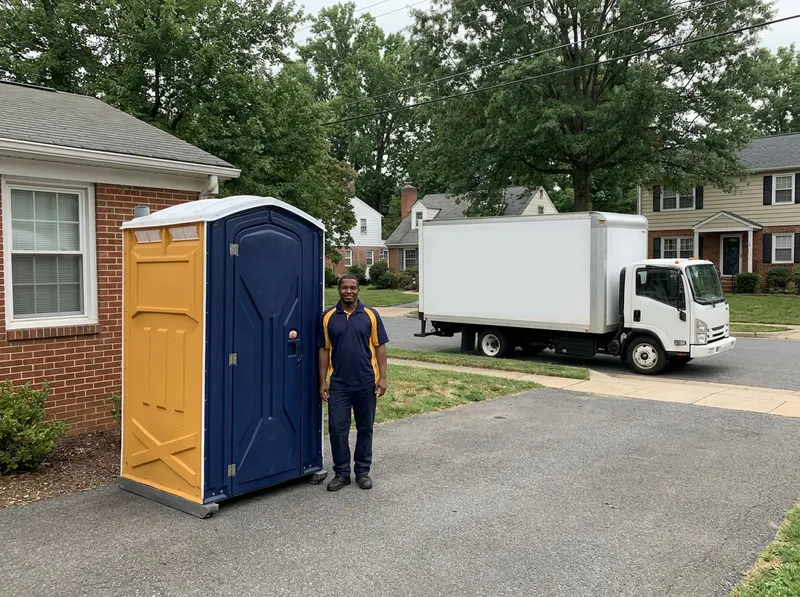
The standard unit is the baseline rental for job sites and general-use crowds where a flushing restroom or handwash station is not required. One standard toilet covers roughly 10 workers on a 40-hour week with one weekly service; add a second unit past that count or bump the service frequency to twice weekly. For a rowhouse renovation on Capitol Hill or a fence crew in Deanwood, a single standard unit set beside the alley or in the front yard is the common setup, because it needs no water hookup and no power, only a flat, firm surface a delivery truck can reach.
Delivery access shapes almost every DC placement. Georgetown's brick sidewalks and narrow one-way blocks off M Street, the terraced lots in Columbia Heights, and the tight service lanes behind Shaw rowhouses all limit where a truck can set a unit, so the door should face away from foot traffic and sit within about 40 feet of where the driver can stop. In Navy Yard and near Yards Park, event and commercial placements often sit on paved lots; on grass or soft ground after Rock Creek Park runoff, a plywood base keeps the unit level. Placements on public sidewalks or streets, common for block parties in Petworth and Brookland, require a District public-space permit that the property owner or event organizer secures before the delivery date.
When the standard unit is not the right pick: choose an ADA-compliant unit for public events open to attendees with mobility needs, add a handwash or hand-sanitizer stand for food-service and catering setups, and step up to a flushing or restroom-trailer unit for weddings and formal gatherings. The trade-off is straightforward, the standard toilet is the lowest cost and fastest to place, while the upgraded units add water, space, and comfort at a higher weekly rate. For a framing crew in Anacostia the standard unit is enough; for a 200-guest reception near the Lincoln Memorial grounds a trailer fits better.
How a rental runs: 1) confirm the placement spot and dates by phone or photo, 2) receive a flat all-in quote at or above the $250 minimum, 3) the unit is delivered and leveled on the agreed spot, 4) the 60-gallon tank is pumped and restocked once weekly for term rentals, and 5) the unit is removed at end of term. A quoted rate excludes only a District public-space permit fee when a placement sits on city sidewalk or street, that fee is paid to the District, not to the rental.
Every job gets a firm, written price after a free on-site visit.
Tell us about your standard portable toilet rental job in Washington and we'll send a clear, written quote, usually the same day.
 Potomac Portable Toilet Rental